This is absolutely amazing.
From an article on Wired, Zillow now practices finding the best houses to Trick Or Treat for Halloween based on
1) Zillow Home Value Index
2) population density
3) Walk Score
4) local crime data
I was pretty fortunate as a kid because there weren't many children in the neighborhood, so people would give my brother and me a lot of candy (which is true, as I TrT'ed at friend's neighborhoods near schools and didn't get anywhere near the quality candy).
However with these new tools, imagine the possibilities:
A) Use Zillow to find the safe, richer neighborhoods.
B) Tweet the houses with the best candy, #street names.
C) Use RunKeeper iPhone app to track exactly when/where they are in the journey, plot tags where the good houses are.
C) Apply the data into Google Spreadsheets by weight and chocolate %.
D) Share the data sets among friends and develop Google Maps w/ colored zones for the following year.
E) Develop a rating scale to houses/streets and publish to a blog, whereby residents then check in how they rated. Residents then compete for best Halloween locals in the following year.
F) Use AdSense from said blog to hire developers to plot this all into an iPhone app itself, which is sold for $.99
Damnit, now when kids come up to my door tonight, I'm just going to say "You're doing it wrong."
Oct 31, 2009

Oct 27, 2009
What's In Brandon's Hand Photo Contest
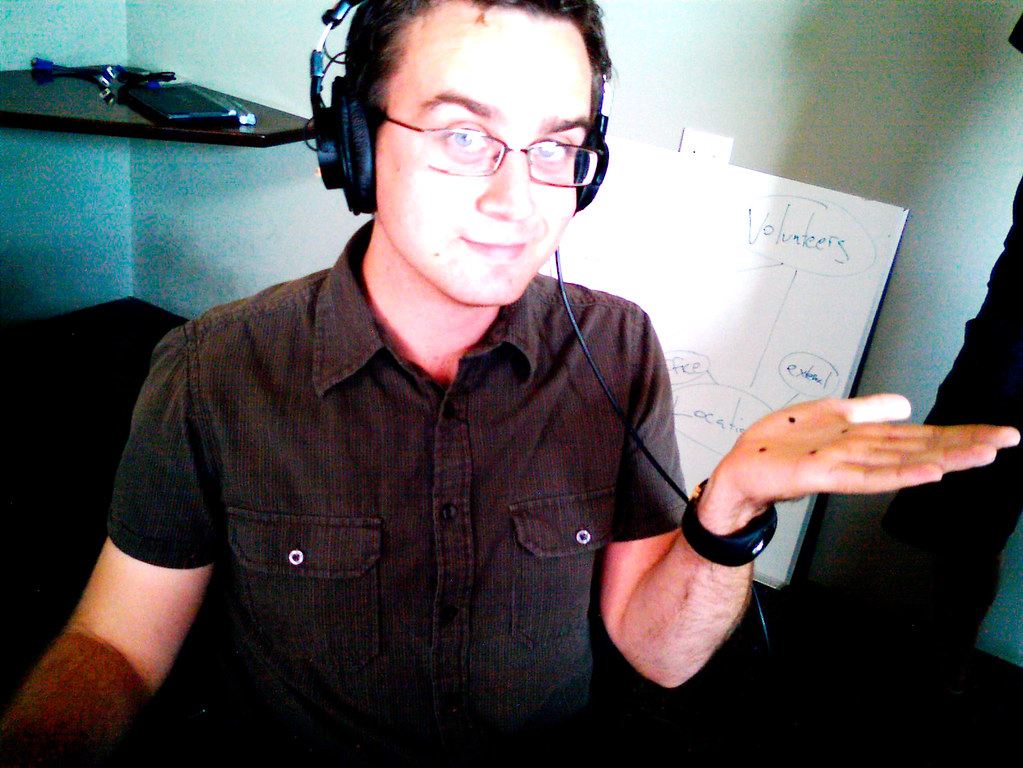
Today launches the first if probably very few Brandon Buck Photo Contests-
WHAT'S IN BRANDON'S HAND?
Composite into this photo (full res here) what is in my hand, and the most creative submission* gets something awesome (and I promise I will send an actual prize that'll be cool). Just post your photos as comments here or email them to me and I'll post them. I'll be tweeting updates as they come along (@brandonthebuck)
The contest ends Thursday, Nov. 20 at 11:59pm PT. GET YOUR SKILZ ON!!
*(Points will be lost if it's a penis, because that's just obvious.)
Oct 20, 2009
Design that explains our world
This week a new video came out that gives a practical visualization of Radio Frequency Identification (RFID) technology (the controversial gadget in a lot of small devices that allows machines to communicate when in short distance with each other; a lot of major gas stations, for example, allow you to swipe a keychain piece that's linked to your credit card so you save 6 seconds when paying for gas).
What seems to have been an emerging trend in the last few years (and I think will only grow) is motion-graphic visualizations like this. We've seen print graphics that describe the principles of radioactivity, for example, and how distance and lead matter in a nuclear meltdown, but the images were always too theoretical to be taken seriously and the concepts so abstract that there was nothing to connect to. However out of video imaging now capable of doing abstract concepts affordably, and Hollywood films exhaustively visualizing abstract concepts ("Bullet Time" to depict sonic-speed), that designers are just moving forward with depicting science.
In this video depicting concepts of magnetic fields, we're given stylistic representations of non-physical elements in a physical world. That still doesn't change the fact that it's an abstract concept: what's the difference between the red loops and blue loops? Not sure. Do I care? Not really; I'm watching a pretty video and feeling smart about it. Win/win.
Immaterials: the ghost in the field from timo on Vimeo.
What seems to have been an emerging trend in the last few years (and I think will only grow) is motion-graphic visualizations like this. We've seen print graphics that describe the principles of radioactivity, for example, and how distance and lead matter in a nuclear meltdown, but the images were always too theoretical to be taken seriously and the concepts so abstract that there was nothing to connect to. However out of video imaging now capable of doing abstract concepts affordably, and Hollywood films exhaustively visualizing abstract concepts ("Bullet Time" to depict sonic-speed), that designers are just moving forward with depicting science.
Magnetic Movie from Semiconductor on Vimeo.
In this video depicting concepts of magnetic fields, we're given stylistic representations of non-physical elements in a physical world. That still doesn't change the fact that it's an abstract concept: what's the difference between the red loops and blue loops? Not sure. Do I care? Not really; I'm watching a pretty video and feeling smart about it. Win/win.
Oct 16, 2009
Google Streetview Trike
I thought I'd volunteer my vacation to drive the Google Streetview car across the country.
But maybe a petition to ride the whole CA coast or some parks in another state would be a better idea.
Oct 15, 2009
doomed.
we really don't want to survive as a species much longer.
gelatinous robots that burst from inside our esophagus:
vertically-driving robots that come into our concrete high-ground fortress:
impervious to physical abuse robots:
torture-intended robots:
gelatinous robots that burst from inside our esophagus:
vertically-driving robots that come into our concrete high-ground fortress:
impervious to physical abuse robots:
torture-intended robots:
Oct 12, 2009
life in the future
Now:
Then:
Though films about the future were made in the silent era, the Great Depression saw a real push in how bright the future will be and how we're making progress toward a life of luxury and simplicity, and this continued through the 1960's during the Cold War. Life was hard. Life was poor. But so long as we put our nose to the grindstone and worked together, we could expect to retire in a world of ease and prosperity.
Jump ahead.
Our lives are easier than ever: just last night I boiled some water in a microwave which made mash potatoes, chicken nuggets and jello for dessert (I was tired, Ryan was sick and yes we skipped our green vegetables. Fuck you.) We watch whatever we want to watch whenever we want to watch in our living rooms, on our laps, or as we walk to work. Every song ever written fits in a matchbox, and I can get up-to-the-minute news on whatever niche I want from any location in the world. This is now as awesome of a future as it's ever going to get. So what will our future films be about now?
Brands! Who's providing the products that give us what we want when we want it? The 1950's brought us the fireless food processor, the 2000's bring us the Kohler Chrome Convection Echo Wave. Which isn't a bad thing. In fact I much prefer a brand to be dipping its toe into these concept designs because that assures us they're that much closer to actually happening. How awesome were the Philips Magnavox ads of the flatscreen TV's and the touch-pad remote controls (with Gomez performing Getting Better)? Sometimes it can get a little carried away (did anyone else wonder who paid for those "Plastics Make It Possible" ads?).
Case in point: design house Oh Hello worked with Microsoft to bring us the future film of 2009- a piece that shows us a day in the life of school and business in a global scale with (as far as I can tell) all cloud-based mobile devices. Videos like this are the wet dream for an amateur motion-graphic designer like me. I've been wanting to make gesture-based computer consoles on video for years, even though it's been done a thousand times over. In fact this video really isn't as impressive as I think it is. 99% of this concept is the result of Gesture Studio's invention (or G-Speak or Oblong Industries, or something or other that Kevin Parent worked on [Brendan, if you read this, please inform me the correct chronology), which was first featured in Minority Report, and the interface design of Stranger Than Fiction created by MK12. It hasn't *really* changed all that much, it's just been a gradual evolution. But that evolution moved it out of the desktop (Tom Cruise's way in MR, and into every peripheral of our lives: where G-Speak was fully 3D manipulation, we have multi-touch and augmented reality in a deck-of-cards-sized that's affordable.
Where am I going with this? We're in such an advanced future now that we don't really care where things are going, we just want to know how to make our lives easier. We want to know how to send the TPS reports to our Japanese clients on-the-fly and that our house is running as efficiently (definition: affordable) as it can, and we don't even have to care. So long as I can watch my "paper" in my garden and know that my daughter's going to be more fluent in Arabic than me by next year, I'm content with where things are going.
"Sustainability", by Mason Nicoll & Oh, Hello studio from Huitième Degré on Vimeo.
Then:
Though films about the future were made in the silent era, the Great Depression saw a real push in how bright the future will be and how we're making progress toward a life of luxury and simplicity, and this continued through the 1960's during the Cold War. Life was hard. Life was poor. But so long as we put our nose to the grindstone and worked together, we could expect to retire in a world of ease and prosperity.
Jump ahead.
Our lives are easier than ever: just last night I boiled some water in a microwave which made mash potatoes, chicken nuggets and jello for dessert (I was tired, Ryan was sick and yes we skipped our green vegetables. Fuck you.) We watch whatever we want to watch whenever we want to watch in our living rooms, on our laps, or as we walk to work. Every song ever written fits in a matchbox, and I can get up-to-the-minute news on whatever niche I want from any location in the world. This is now as awesome of a future as it's ever going to get. So what will our future films be about now?
Brands! Who's providing the products that give us what we want when we want it? The 1950's brought us the fireless food processor, the 2000's bring us the Kohler Chrome Convection Echo Wave. Which isn't a bad thing. In fact I much prefer a brand to be dipping its toe into these concept designs because that assures us they're that much closer to actually happening. How awesome were the Philips Magnavox ads of the flatscreen TV's and the touch-pad remote controls (with Gomez performing Getting Better)? Sometimes it can get a little carried away (did anyone else wonder who paid for those "Plastics Make It Possible" ads?).
Case in point: design house Oh Hello worked with Microsoft to bring us the future film of 2009- a piece that shows us a day in the life of school and business in a global scale with (as far as I can tell) all cloud-based mobile devices. Videos like this are the wet dream for an amateur motion-graphic designer like me. I've been wanting to make gesture-based computer consoles on video for years, even though it's been done a thousand times over. In fact this video really isn't as impressive as I think it is. 99% of this concept is the result of Gesture Studio's invention (or G-Speak or Oblong Industries, or something or other that Kevin Parent worked on [Brendan, if you read this, please inform me the correct chronology), which was first featured in Minority Report, and the interface design of Stranger Than Fiction created by MK12. It hasn't *really* changed all that much, it's just been a gradual evolution. But that evolution moved it out of the desktop (Tom Cruise's way in MR, and into every peripheral of our lives: where G-Speak was fully 3D manipulation, we have multi-touch and augmented reality in a deck-of-cards-sized that's affordable.
Where am I going with this? We're in such an advanced future now that we don't really care where things are going, we just want to know how to make our lives easier. We want to know how to send the TPS reports to our Japanese clients on-the-fly and that our house is running as efficiently (definition: affordable) as it can, and we don't even have to care. So long as I can watch my "paper" in my garden and know that my daughter's going to be more fluent in Arabic than me by next year, I'm content with where things are going.
Oct 5, 2009
Oct 4, 2009
The Premiere in Advert
Perfect concept, perfect execution.
Unfortunately the extent to any of my long takes only entails 2-3 timed events.
Unfortunately the extent to any of my long takes only entails 2-3 timed events.
Oct 2, 2009
god help me, i want to see.
Do you think Christopher Nolan, when pushing for the studio to allow him to use IMAX cameras to shoot "The Dark Knight," could have anticipated that he would just be perpetuating more crap?*
Because when I see this,
I think to myself, "Boy do I want to see that in IMAX."
*(Yes, technically regular theatrical films presented in IMAX began with Ron Howard's "Apollo 13," but Howard already provides us with crap anyway).
Because when I see this,
I think to myself, "Boy do I want to see that in IMAX."
*(Yes, technically regular theatrical films presented in IMAX began with Ron Howard's "Apollo 13," but Howard already provides us with crap anyway).
Subscribe to:
Posts (Atom)