I really wish we had known a year ago that YouTube saves the raw, uploaded video and re-encodes as needed. We used to do our best to compress the video so it looked best when streamed at 640x360.
There wasn't even a low-quality/high-quality option then.
Now we just compress to make the file size a bit smaller for our own storage.
I am glad, though, that the call was made to go 16x9 before I came onboard and that's been consistent since day one.
Dec 29, 2009

Dec 28, 2009
Giving Back: Public Enemy in D.C.
Reposted from Sounds of VTech
On November 18th, Virgin Mobile brought Public Enemy to D.C. for a good cause. To celebrate the three year anniversary of National Homeless Awareness Month designated by Congress through the efforts of the RE*Generation, Virgin Mobile’s charity arm. Proceeds from the event went to benefiting homeless youth, helping them keep warm, and giving back to the Sasha Bruce House, where a young person who needs a place to stay- for any reason- can find a home here.
Virgin Mobile sponsored an early Thanksgiving dinner at the Sasha Bruce House with Public Enemy, with a tour of the shelter and participated in a Q&A session with the kids and press.
Once they finished, they proceeded to George Washington University’s Lisner Auditorium in true Public Enemy style, on the back of a flat bed truck! Livening up the mood by giving a small performance on the streets of D.C. before taking the stage for one unforgettable night.
“Don’t believe the hype. Just because everyone says the economy’s coming back doesn’t mean that homeless kids don’t need a place to sleep and keep warm.” Flavor Flav of Public Enemy
Check out the video below presented by VTech in partnership with Virgin Mobile and The RE*Generation from that memorable evening.
- - -
What I'm really loving is the video player offers "HTML5 and Flash" embed for non-social networking sites, so everyone's getting on the html5 bandwagon (which, again, will make all online video easily [thus massively] more interactive and actionable).
Pretty slick video, c/o Harmonie, Brandon D. & intern Matt.
On November 18th, Virgin Mobile brought Public Enemy to D.C. for a good cause. To celebrate the three year anniversary of National Homeless Awareness Month designated by Congress through the efforts of the RE*Generation, Virgin Mobile’s charity arm. Proceeds from the event went to benefiting homeless youth, helping them keep warm, and giving back to the Sasha Bruce House, where a young person who needs a place to stay- for any reason- can find a home here.
Virgin Mobile sponsored an early Thanksgiving dinner at the Sasha Bruce House with Public Enemy, with a tour of the shelter and participated in a Q&A session with the kids and press.
Once they finished, they proceeded to George Washington University’s Lisner Auditorium in true Public Enemy style, on the back of a flat bed truck! Livening up the mood by giving a small performance on the streets of D.C. before taking the stage for one unforgettable night.
“Don’t believe the hype. Just because everyone says the economy’s coming back doesn’t mean that homeless kids don’t need a place to sleep and keep warm.” Flavor Flav of Public Enemy
Check out the video below presented by VTech in partnership with Virgin Mobile and The RE*Generation from that memorable evening.
FULL SCREEN
The Sounds of VTech / oc_vtech_final7-largeqt 
- - -
What I'm really loving is the video player offers "HTML5 and Flash" embed for non-social networking sites, so everyone's getting on the html5 bandwagon (which, again, will make all online video easily [thus massively] more interactive and actionable).
Pretty slick video, c/o Harmonie, Brandon D. & intern Matt.
Dec 12, 2009
genuine.
Despite how ridiculously geeky it is, if I were to go back to school or take night classes, it'd probably be on a few areas in visual effects; notably
motion tracking:
(which I dabbled with in this week's reel I compiled for Causecast, posting early next week),
and fractal sofware:
The last piece reminds me a lot of the Electric Sheep screensaver program, which in terms of how the code evolves still fascinates me.
motion tracking:
Box Animation from Jordan Clarke on Vimeo.
(which I dabbled with in this week's reel I compiled for Causecast, posting early next week),
and fractal sofware:
Syn Emergence from RICH BEVAN on Vimeo.
The last piece reminds me a lot of the Electric Sheep screensaver program, which in terms of how the code evolves still fascinates me.
Dec 8, 2009
photography

Two weeks ago while home for Thanksgiving in Santa Barbara, I took a few extensive panoramic High Dynamic Range (HDR) photos in some very scenic spots. This picture is some 28 stills combined together and was barely possible for my computer to render into a regular panorama (I had to convert the RAW files to JPEG's and shrink them 1/4 the size), let alone a proper HDR. Eventually it'll be a weekend project to do the process right, demanding some play with a few different programs and a whole lot of render time.
And what will be the result? Another picture, pretty similar to this one.
So why bother? No real reason. I find it interesting, despite not having a valid argument as to why HDR's actually matter. They're not much more than interesting concepts and pretty unpractical for any normal use. So why do I do it? Because the historical significance of photography absolutely astounds me, and it feels like technology is finally catching up to making this practical.
First, we have the HDR factor. Right now, the color fidelity and light range of the camera is limited, so taking two extra exposures at +2 and -2 full stops and combining them together renders a picture with far more range: able to see fully into the shadows and highlights, so we're not losing any data from light limitations.
Second, as a panorama, I'm able to take a larger field of view into a single spot. Taking a massive picture with a solid 50mm lens at a very low aperture renders a lot of detail, especially when you intend the final image to be completed larger-than-life (a bit of a stretch in this instance, because 50mm isn't that long and I'm already shooting something larger-than-life, but my 70-300mm zoom has worn with age). The dream would be to have the tools used by the Gigapixel project, which is a servo-tripod that automatically triggers off exposures at a calculated overlap, taking out over- or under-compensation for the whole image.
xRez Studio 2009 Yosemite Reel from xRez Studio on Vimeo.
Not only does that video show a photo project that creates an historic image at an exact time and place, but touches on how it was also used for geologic study and safety- quantifying ongoing research as well as historical significance.
I keep touching on the historical aspect because when my grandmother passed away a few years ago I was given her boxes of prints and negatives that showed Santa Barbara back in the 1940's. How amazing would it be to be if we knew its GPS coordinates and took a photo of that exact spot now, comparing 60+ years of change? The technology is finally catching up: look at this example of Microsoft's Photosynth, which composites a photo taken from Harry Houdini's stunt at Mass Ave. Bridge to the bridge as it appears now.

This is what Microsoft, Google, and iPhoto have been head-to-head competing for: trying to establish themselves as new standards in photo organization. But there's a new field that I'm certain is where the competition lies and isn't fully public.
Google and Microsoft both have vast amounts of satellite maps and streetviews freely available online to show us above and on the ground. Sure, satellite maps give us an outstanding layout of where things are, but streetview never really seemed that practical in comparison. Over 10 years ago, Dr. Paul Debevec wrote his doctoral thesis on the principles of photogrammetry: rendering 3D maps of places based on just a handful of photos. In school, he flew a kite around UC Berkely campus and used around 20 shots of the belltower that a computer modeled into a 3D shape and projected the photo onto the shape, rendering a simple photo-realistic digital model (the technique was used in "The Matrix" and "Fight Club" in 1999 to quickly and affordably create virtual backgrounds). As an intern at Mahalo, I got to meet Dr. Debevec and made a Mahalo Daily about the process.
So what do you need to make a 3D model of something? Nothing more than a handful of photos around the object taken at different locations that a computer can align together, model and paste. Exactly what streetview has been doing for 3 years.
But for the most part, Google and Microsoft haven't been dabbling in 3D. A paid version of Google Earth offers a few buildings in major US cities rendered in 3D, but not much more. That is until last week, when Google announced their "Model Your Town" competition.
Though the competition is about manually generating 3D cityscapes, I think that this is a leg-up in 3D modeling on a massive, massive scale, and a move to get the public excited about the prospect. Modeling like this is expensive and very processor-heavy, so any assistance they can get in the process is very valuable (in fact hugely valuable if the only prize is your work being included in the software: 100% free labor). Not doing it for this long was probably 1) lack of demand, 2) lack of resources and reference elements, and 3) a bottom line. Is doing this a Google "organize the world's information," or offering the next generation of sell-able product for nearly unlimited uses (selling the software to news programming alone would make up the cost).
I'm certain this is at least what Google has up its sleeve next. Microsoft's Photosynth software has been doing this for 3 years, but in a less-visible, less-practical way, so I'm also certain they could roll this out quickly. And what we'll have then is a virtual map of America as it looked between 2007-2010. And every photo taken thereafter by anyone that logs the date and GPS location (and placed online) will update that map, logging its full history from-then-to-now.
>>UPDATE<< Again, I'm a week late in addressing this, but I think with Google Goggles, this TOTALLY makes sense from their perspective.
Take for example this StreetView of Bagel Nosh in Santa Monica. If Google was only able to take these two frames of the restaurant, that's all well and good while I'm in Streetview.
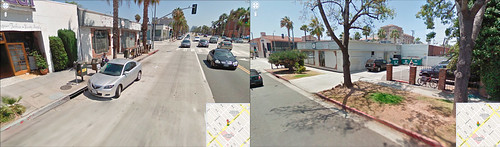
But this won't apply at all if I'm on the sidewalk and I take a pic from the building at any other angle. That's where 3D modeling would come in: Google would be capable of knowing the full extent of what this building looks like, so it doesn't matter where I take the Google Goggle photo from- they'll be able to figure it out. Taking a picture of a triangle and a circle, the computer sees two different things; tell the computer that it's the same object from two angles and the computer will know it's a cone.
There's the financial incentive for photogrammetry. Now if it's financially sound enough to do, that's for Google to decide.
Dec 3, 2009
Ben Stiller tells Lance Armstrong about Stillerstrong, his "original idea"
Today is the debut of a website Causecast has been involved with that I'm really excited about.
A few weeks ago, Ben Stiller wanted to create a campaign called "Stillerstrong" to raise money toward building a school in Ceverine, Haiti (from a visit he made with a Causecast featured organization Save The Children). He and his team went to Save The Children directly with all these ideas of donation and site building, and STC said "Causecast is a better fit for doing these sort of things," (which is exactly Ryan Scott's intention when he founded CC: NPO's should not be spending their resources on logistics that can be handled by technology or professionals).
So we built the site Stillerstrong.org as a home for finding information, selling merch, donating via credit and via Causecast Mobile, and in the early parts of negotiation, I lobbied that they ought to be using our YouTube account for its additional features not available to any non-nonprofit partner. That is, buttons that bounce *out* of YouTube.
Any user, partner or not, can create buttons on their video ("Annotations" as YT calls them), but they can only do things that keep you on YouTube: send a message, video comment upload, collaborative annotations, etc. Unfortunately few know this, and very few know how to do it well. I blogged earlier about one design firm that was very clever about their use of annotations, and my friend Michael Gallagher of Totally Sketch also used them very keenly to create a "Choose Your Own Adventure" video series (this is brilliant because it increases engagement, viewcounts, search engine optimization, storytelling possibilities, etc. etc.) But again, every one is limited by only having traffic on youtube, not outside.
So what did we do for the Stillerstrong campaign?
1) Created a banner that has the text-2-give info, so people can donate on the spot without having to click anything,
2) Link to the donate page (this is why YT offers the ability for NPO's to bounce out),
3) Link to the merchandise page,
4) Link to post the video to Facebook: posting the video itself to FB allows people to watch without having to go to any page, and the buttons are just as functional,
5) Link to tweet: click the button and it'll take you to Twitter with a pre-written tweet, which includes Ben's name, the celeb's Twitter name (if applicable [which becomes really important when celebrities with massive twitter followers get mentioned in future videos]), and link to the homepage.
Pretty awesome.
This is why I never wanted to bother working for television or film. For more than a decade, the argument has always focused on how Hollywood is dying because audiences are watching content on alternative sources; the "third screen" as it's often called. People prefer to tune in on their phones for convenience and thus have the attention-span of a goldfish. And I've been saying for more than a decade that that's bullshit: 2001: A Space Odyssey is supposed to be seen in a theatre on a large screen, Ben Stiller asking for donations is not. Ben Stiller is asking for money and awareness for a cause by using a tool he's fit for (onscreen presence), and only by using online video can that be accomplished. You can't tweet by television. You can't hand your credit card number to a television. The television can tell you to do so, but why watch on one device and take action on another when you can do both with one? This is why film and TV are dying mediums: their audience is actionless and thus dead. Online video is commentable, shareable, referencable, resizeable, copy+and+pasteable, skipable, speed-up-or-slow-downable, watch-at-any-timeable, watch-as-many-timeable, and watch-anywhereable.
This isn't just YouTube, but thankfully to the competition of online video, they've been keeping pace with offering tools to stay at the top of the market. And believe me that this is only the first step to what Causecast has in store (I really can't wait to launch what we've been cooking up recently). And of course this is also why I'm so excited for html5 despite not being a coder: functionality, action and consumption of video will be on steroids compared to what we can do now, and the definition of "online video" will be anything but a rectangular-contained box you sit and watch.
Subscribe to:
Posts (Atom)