So now that we've gone through the first decade of the 21st century, everyone and their mother has put together Top 10 Film lists. It's amazing to recognize how far we've come, especially for titles that feel like they were released forever ago: I remember watching
Amelie with my high school crush, or going to seminars at the Santa Barbara Film Festival where producers and independent filmmakers debated whether
The Blair Witch Project would be the beginning or end of Hollywood (yes,
Blair Witch was technically released in 1999, but this topic is
still under debate at nauseam today).
But I'm not really interested in making a list of my top-ten favorites, and you're probably not interested in reading another (they're all basically the same). What interests me more is trying to figure out what films had more lasting affects on other films in the decade, and on pop culture as a whole. Rather than put them numerically, I've placed everything categorically, and will try to sum the different areas down to only one film if possible.
Most Influential To StyleThe Royal Tenenbaums
If there was one adjective for the style of films in the 2000's, it's "quirky." Awkward humor, no punchlines, focus on embarrassing moments instead of the ridiculous; it was everywhere. Wes Anderson had already established his visual and narrative style clearly with
Bottle Rocket and
Rushmore, but
Tenenbaums really explored a retro-style that hadn't quite been put on film. Anderson flashbacked to his own childhood in the 70's and 80's: headbands, pastel colors, hand drawings, record players; and we ate it up.
Tenenbaums lead the way for
Noah Baumbach,
Jason Reitman,
Jared Hess,
Michel Gondry, and on and on.
Combine
Tenenbaums throwbacks with
Donnie Darko's surprisingly influential "80's was cool" mantra, and you create the "hipster" movement that stormed pop-culture in the last 2-3 years.
Most Influential to TechniqueTraffic
This is a bit less tangible, because there really wasn't anything original in this, however it still had its effect nonetheless. First,
Traffic was influenced directly from the
Dogme '95 movement, according to director Soderbergh, and his method was much more similar to the indie movement in the 1970's (
Saturday Night Fever,
The French Connection, etc.). The film was sharp, grainy, handheld, color-dial set-to-11. The story was multi-tiered, unraveling, and sombre-but-frank in its portrayal.
Though this film lacked originality in the sum of its elements, it did show Hollywood that these films are profitable and respected. This encouraged the behaviors of directors who had the same eye to make films in this style:
Paul Greengrass,
Alfonso Cauron,
Christopher Nolan, and more.
Gladiator, which also came out in the same year, garnered more attention and also featured much of the same style,
Traffic's more personal, domestic story and lack of epic visual effects had the further-reaching effect to Hollywood.
Most Influential to PhotographyCidade de Deus (City of God)
What
Traffic did to visual style,
City of God did on steroids. And again, everyone ate it up. What differed from
Traffic in this case was super-saturation and vivid colors, often with 2-3 strong color lightsources in the same frame. This film was basically remade as
Man on Fire and gave Tony Scott a leapfrog to the style he was already developing on his own, as well as for
Gore Verbinski,
Michael Bay,
Saw and every "horror-porn" film made afterward.
 Most Influential to Visual EffectsLord Of The Rings: The Two Towers
Lately everyone's
been in a huff about George Lucas making
Phantom Menace too soon because character animation was nowhere near strong enough to carry on a film. Apparently proper maturity was only 3 years away when Peter Jackson created emotional performances in the character Gollum. James Cameron
said he knew Avatar was ready to begin production after Gollum's performance. Although
Pirates Of The Caribbean: Dead Man's Chest did a far better job at rendering CG characters four years later, it would not have happened without Gollum leading the way. Ontop of that, the program MASSIVE was invented to create crowd simulations, which has been used in dozens of major films and hundreds of commercials. And all of the action scenes had real and artificial handheld camera moves, which are now the entire basis of some films:
Cloverfield,
Spiderman,
War of the Worlds, etc.
- - -
Now that the decade's up, where will things be moving?
Epic Tentpoles v. Micro DigitalThe gamut between the large and small will widen. Theatre attendance is at an all-time low, and the only way to curb that for now is 3D. Most major Hollywood films are being shot in 3D, animated films can easily be rendered to 3D, and the cost to make 3D from a 2D source is low enough to make its money back in no time (
Nightmare Before Christmas, the often-publicized and soon-to-come original
Star Wars films, etc.). Add to that
The Dark Knight shooting 30% of the film in IMAX format, the rumors that the next film will be shot 100% in IMAX, and the revenue incentive to do an IMAX blowup for every major film, the epic tentpole films are here to stay.
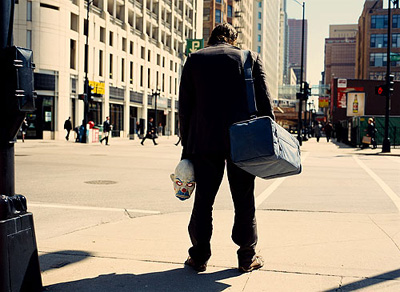
But.
HD-DSLR's came out of nowhere in 2008. In fact they grew in popularity so quickly that a lot of the initial buyers are regretting jumping the gun (limit in color range, noticeable compression artifacts, "jello-vision," to name a few). But regardless, they are setting a precedent that you can get 80% of the job of making something look like it was shot on 35mm cost ~$5000. That fact alone has RED pulling their hair to parallel their digital cinema technology to fit the market (their RED ONE, released only 3 years ago, comes at ~$30,000 for the system). Hollywood went bananas for
District 9, costing $30 million and looking like >$100 million, and
Paranormal Activity, costing $15,000 and earned over $100 million, so there's going to be pressure to make <$1 million films perform on-par with the $200 million film counterparts.
That is, of course, if they're still released in theatres. YouTube debuted in 2005 and streams feature-length 1080p films (along with Hulu and Netflix), and although no one's set the deal to be a producer/distributer solely online (Netflix tried and failed), we're going to see a huge wave of feature-length films and episodic series stream online and look almost as good as what we'd see in theatres.
Truly Interactive Media
Only in the last year has
"augmented reality" become popular, but it hasn't yet become mainstream, mostly because the technology and adoption is 90% there. We'll be seeing location-based films and interactive performances: imagine walking up to a closed-off spot in a shopping mall and being able to watch a major band or artist perform a song from any standpoint on your phone, or scenes from
Indian In The Cupboard in actual size after you purchased a special box of cereal.
Long, long-form storytelling
In the 1970's, everyone in the country watched the same major TV series, which were always the hot topic at the office or on the weekends. In the 1990's, there were so many shows to watch that the size of audience diminished and so there was no one to catch you up on the show if you missed an episode; shows typically ended after a few seasons for lack of interest. DVD's of shows turned out to be a huge success, and along with streaming online through Hulu (or illegally), people could easily catch up on what they missed. Haven't seen
24? Catch up on 7 seasons so you can tune in when Season 8 starts in two weeks. You can catch up literally any time of day, so hearing someone admit to watching entire runs over 3-day weekends is not uncommon, and will only increase now that TV shows are shifting around their seasons (no more Summer or Winter breaks).
Back To Style
Realism had its time to shine throughout the 90's, so 00's was naturally extraordinary circumstances told in ultra-realistic settings (
Eternal Sunshine of the Spotless Mind,
Cloverfield,
Where The Wild Things Are). I believe we're turning back to stylized, less-realistic films visually. Films like
Hurt Locker run against this theory, and though there will still be very realistic films, I think as a whole we're moving back to "control." This is very apparent with television:
ER is over and is now the highly-glossy (and not-short-enough lived)
Trauma tried to fill its place. All of USA and CBS shows are classy supermodels in post-modern,
Miami Vice conflicts. And I even hate to admit that
The Dark Knight was a lot more stylized and beautifully composed than the realistic, worn
Batman Begins, which was its most charming factor.
All in all, this first decade showed a very wide range of themes and appearances that are really hard to quantify into "movements;" such words should be left to professionals and smarter people to describe. And because of that, it's very difficult to anticipate what'll be in store for the next decade, only because equally as dramatic is the evolution in how films are consumed (the biggest changes happened in only the last few years). The part I'm most excited for is how the democracy of the medium has moved: where dedicated and equally-talented amateurs are the voices of the change in media (Lonely Island, Derrick Comedy). And although I don't enjoy the quality that comes from some of YouTube's top videomakers, I'm glad to know that the scale of those who choose their own source of entertainment number in the millions, and even they're trying to figure out what that medium really means.

(note: SNL
shoots some footage, including opening title sequences, on Canon 5DmII and 7D cameras)