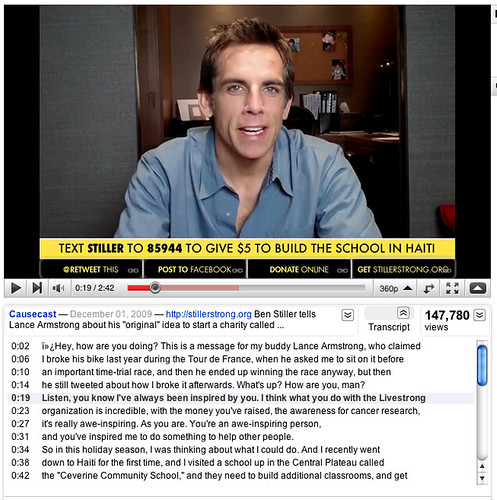
Everyone knows (or at least every video maker should know) that adding closed-captions to your videos really helps SEO (because text is much easier for bots to crawl than video, pictures and audio). Before, the closed captions were part of the flash within YouTube videos, but now with "Interactive Transcription" YouTube's playing with, I'm guessing a few things:
1) the video landing page becomes SEO for other search engines like Bing, Yahoo, or whatever;
2) this is a step to help them transition to HTML5, which handles closed captions like text within javascript (here's an example of captions in an HTML5 video, notice how you can select and copy the transcript just like regular text on a page);
3) clicking the text jumps forward to that point in the timeline of the video: for example, news sites can watch the video of a press conference and instantly jump to the segment they want without having to scrub through the timeline.
Again, to me, this is a really huge step for YouTube to be moving toward making the video an integral part of the website, and as I've saidmany times, I think the overall movement of online video is to step away from being considered "video," and simply just a website in of itself.
This video is basically the pinnacle of YouTube as of right now:
Hand-made Stop Motion
Cheap digital still cameras and the huge pop-culture success of Michel Gondry 2006-2008 made everyone want to emulate stop-motion animation. People share these like crazy. It's awesome, but I think it'll finally wane by mid-2010.
Full HD
360p to 1080p, this video can be viewed on as low- or as high-quality as YouTube can offer, and on any device YouTube can stream to.
Cute
Vocal sound effects and catchy, simple music recorded on a desktop computer.
Shot at home in a basement.
Expressive faces, like something out of a high school skit.
Action Annotations
Credits for the video aren't just names, they're links to their profiles, encouraging you to subscribe. Like the music? Go to the musician's page and hear all of their songs. And because it exists on the video itself ("baked-in"), the links work no matter where it's posted: MySpace, Facebook or this blog.
Sub-video categories
Jump to the behind-the-scenes companion video literally as the video's still playing.
Links everywhere
The description has links to buy the song in 3 different places, to each filmmaker's YouTube page, Twitter, Facebook and DailyBooth.
Merchandising like crazy
You can buy the song (both with and without lyrics) and all the shirts, and AdSense on the video are all revenue models for this one piece: the video is a vehicle for the sales, and the sales are only possible from the video. 1000x more bang-for-the-buck than the Transformers franchise.
Got a link this morning that said it would be about how WIRED is prepping their new form of digital publishing for the iPad, though it's actually an Adobe commercial about how Flash is keeping up with the technology.
These concepts they're showing are obviously awesome, and I'm sure specifically Adobe's bidding war for WIRED exclusivity was an arm and a leg alone. WIRED clearly has a lot of tricks up their sleeve that they've been holding off for a while in anticipation, and I'm really pleased that the ideas go beyond the concepts Popular Science had in their video (which I blogged about earlier before the iPad was announced).
As they say in the video, it's a really exciting time for publishing. And that could be said for all content publishing, not just magazine print. Andy Ihnatko had a prediction that as soon as Apple announced their product, every computer manufacturer and design software company would finally release their products to compete head-to-head (they just held back so far to simply know what they'd be up against), and that's clearly been happening in only a short month.
Not only are the concepts here really great, as I said, but this is also going to be a really huge year simply in terms of how any publisher online is presenting their content. One major site that I know of is changing their layout entirely in a way that really takes advantage of how it interacts with multi-touch (and yet is still perfectly functional via keyboard and mouse).
One final note I think is pretty interesting is how a lot of publishers and advertisers have basically been setting the stage for this kind of media, whether they were aware of it or not. Shopping malls have been using large plasma screens lately to add life to their images (literally the case with the movie posters for Step Brothers and Bride Wars), and two years ago Esquire made a really huge change in their pipeline by doing their Megan Fox cover shoots with a RED One video camera (instead of the standard medium-format).
The only downside, of course, to all of this is how WIRED will be having to using Flash for their site, which will make things slow, large, difficult to search and share, and hold everything behind a different kind of paywall that a lot of publishers are playing with. Competition's good: it'll bring a ton of creative and technical innovation that'll be really exciting, but it'll also bring a long road of awkward pricing and saturation in the market (like the music industry, film industry and now e-book industry). I predict it'll actually be around 3 years for the print-publishing industry to make sense of it.
UPDATE: Volvo announces touchscreen-based rear seat entertainment system
Evidence that hardware and software manufacturers were just waiting for Apple to announce something before launching their products, and proof that everything (everything) moving in the multi-touch direction.
As chef Andrew Gruel and marine biologist Dave Anderson cooked, the video team captured them on camera talking about the history of their organization, why it’s important to maintain seafood as a part of a healthy diet and how they’re going about convincing the fishing industry and the restaurant industry to go sustainable. They also explained the incentives they offer customers who choose sustainable dishes.
Because Andrew and Dave had so many insightful things to say, we did something a little special with this video. Normally our videos are around three to four minutes long, so we also provided links in the video to other parts where Dave and Andrew go into more detail about certain things, whether it’s more on the health benefits of having seafood in your diet, or about how you can shop sustainably at your local grocery store or restaurant.
We also couldn’t leave you without recipes of all the delicious dishes Andrew made, so we included links at the very end of the video that you can click on that will take you directly to the recipes.
- - -
I was really happy with how this video mini-series came out. I had 4.5 solid hours of footage to work with, and I didn't want to spend too long editing so many things because it was still more of a conceptual piece that showed how video could be more interactive. If given long enough time, we would have eventually gone into each dish individually, more about sustainability for each ingredient, etc. There are so many directions to go, but ultimately I hope we do more like this in the future.
Two weeks ago while home for Thanksgiving in Santa Barbara, I took a few extensive panoramic High Dynamic Range (HDR) photos in some very scenic spots. This picture is some 28 stills combined together and was barely possible for my computer to render into a regular panorama (I had to convert the RAW files to JPEG's and shrink them 1/4 the size), let alone a proper HDR. Eventually it'll be a weekend project to do the process right, demanding some play with a few different programs and a whole lot of render time.
And what will be the result? Another picture, pretty similar to this one.
So why bother? No real reason. I find it interesting, despite not having a valid argument as to why HDR's actually matter. They're not much more than interesting concepts and pretty unpractical for any normal use. So why do I do it? Because the historical significance of photography absolutely astounds me, and it feels like technology is finally catching up to making this practical.
First, we have the HDR factor. Right now, the color fidelity and light range of the camera is limited, so taking two extra exposures at +2 and -2 full stops and combining them together renders a picture with far more range: able to see fully into the shadows and highlights, so we're not losing any data from light limitations.
Second, as a panorama, I'm able to take a larger field of view into a single spot. Taking a massive picture with a solid 50mm lens at a very low aperture renders a lot of detail, especially when you intend the final image to be completed larger-than-life (a bit of a stretch in this instance, because 50mm isn't that long and I'm already shooting something larger-than-life, but my 70-300mm zoom has worn with age). The dream would be to have the tools used by the Gigapixel project, which is a servo-tripod that automatically triggers off exposures at a calculated overlap, taking out over- or under-compensation for the whole image.
Not only does that video show a photo project that creates an historic image at an exact time and place, but touches on how it was also used for geologic study and safety- quantifying ongoing research as well as historical significance.
I keep touching on the historical aspect because when my grandmother passed away a few years ago I was given her boxes of prints and negatives that showed Santa Barbara back in the 1940's. How amazing would it be to be if we knew its GPS coordinates and took a photo of that exact spot now, comparing 60+ years of change? The technology is finally catching up: look at this example of Microsoft's Photosynth, which composites a photo taken from Harry Houdini's stunt at Mass Ave. Bridge to the bridge as it appears now.
This is what Microsoft, Google, and iPhoto have been head-to-head competing for: trying to establish themselves as new standards in photo organization. But there's a new field that I'm certain is where the competition lies and isn't fully public.
Google and Microsoft both have vast amounts of satellite maps and streetviews freely available online to show us above and on the ground. Sure, satellite maps give us an outstanding layout of where things are, but streetview never really seemed that practical in comparison. Over 10 years ago, Dr. Paul Debevec wrote his doctoral thesis on the principles of photogrammetry: rendering 3D maps of places based on just a handful of photos. In school, he flew a kite around UC Berkely campus and used around 20 shots of the belltower that a computer modeled into a 3D shape and projected the photo onto the shape, rendering a simple photo-realistic digital model (the technique was used in "The Matrix" and "Fight Club" in 1999 to quickly and affordably create virtual backgrounds). As an intern at Mahalo, I got to meet Dr. Debevec and made a Mahalo Daily about the process.
So what do you need to make a 3D model of something? Nothing more than a handful of photos around the object taken at different locations that a computer can align together, model and paste. Exactly what streetview has been doing for 3 years.
But for the most part, Google and Microsoft haven't been dabbling in 3D. A paid version of Google Earth offers a few buildings in major US cities rendered in 3D, but not much more. That is until last week, when Google announced their "Model Your Town" competition.
Though the competition is about manually generating 3D cityscapes, I think that this is a leg-up in 3D modeling on a massive, massive scale, and a move to get the public excited about the prospect. Modeling like this is expensive and very processor-heavy, so any assistance they can get in the process is very valuable (in fact hugely valuable if the only prize is your work being included in the software: 100% free labor). Not doing it for this long was probably 1) lack of demand, 2) lack of resources and reference elements, and 3) a bottom line. Is doing this a Google "organize the world's information," or offering the next generation of sell-able product for nearly unlimited uses (selling the software to news programming alone would make up the cost).
I'm certain this is at least what Google has up its sleeve next. Microsoft's Photosynth software has been doing this for 3 years, but in a less-visible, less-practical way, so I'm also certain they could roll this out quickly. And what we'll have then is a virtual map of America as it looked between 2007-2010. And every photo taken thereafter by anyone that logs the date and GPS location (and placed online) will update that map, logging its full history from-then-to-now.
>>UPDATE<<
Again, I'm a week late in addressing this, but I think with Google Goggles, this TOTALLY makes sense from their perspective.
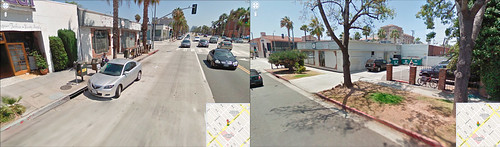
Take for example this StreetView of Bagel Nosh in Santa Monica. If Google was only able to take these two frames of the restaurant, that's all well and good while I'm in Streetview.
But this won't apply at all if I'm on the sidewalk and I take a pic from the building at any other angle. That's where 3D modeling would come in: Google would be capable of knowing the full extent of what this building looks like, so it doesn't matter where I take the Google Goggle photo from- they'll be able to figure it out. Taking a picture of a triangle and a circle, the computer sees two different things; tell the computer that it's the same object from two angles and the computer will know it's a cone.
There's the financial incentive for photogrammetry. Now if it's financially sound enough to do, that's for Google to decide.
Today is the debut of a website Causecast has been involved with that I'm really excited about.
A few weeks ago, Ben Stiller wanted to create a campaign called "Stillerstrong" to raise money toward building a school in Ceverine, Haiti (from a visit he made with a Causecast featured organization Save The Children). He and his team went to Save The Children directly with all these ideas of donation and site building, and STC said "Causecast is a better fit for doing these sort of things," (which is exactly Ryan Scott's intention when he founded CC: NPO's should not be spending their resources on logistics that can be handled by technology or professionals).
So we built the site Stillerstrong.org as a home for finding information, selling merch, donating via credit and via Causecast Mobile, and in the early parts of negotiation, I lobbied that they ought to be using our YouTube account for its additional features not available to any non-nonprofit partner. That is, buttons that bounce *out* of YouTube.
Any user, partner or not, can create buttons on their video ("Annotations" as YT calls them), but they can only do things that keep you on YouTube: send a message, video comment upload, collaborative annotations, etc. Unfortunately few know this, and very few know how to do it well. I blogged earlier about one design firm that was very clever about their use of annotations, and my friend Michael Gallagher of Totally Sketch also used them very keenly to create a "Choose Your Own Adventure" video series (this is brilliant because it increases engagement, viewcounts, search engine optimization, storytelling possibilities, etc. etc.) But again, every one is limited by only having traffic on youtube, not outside.
So what did we do for the Stillerstrong campaign?
1) Created a banner that has the text-2-give info, so people can donate on the spot without having to click anything,
2) Link to the donate page (this is why YT offers the ability for NPO's to bounce out),
3) Link to the merchandise page,
4) Link to post the video to Facebook: posting the video itself to FB allows people to watch without having to go to any page, and the buttons are just as functional,
5) Link to tweet: click the button and it'll take you to Twitter with a pre-written tweet, which includes Ben's name, the celeb's Twitter name (if applicable [which becomes really important when celebrities with massive twitter followers get mentioned in future videos]), and link to the homepage.
Pretty awesome.
This is why I never wanted to bother working for television or film. For more than a decade, the argument has always focused on how Hollywood is dying because audiences are watching content on alternative sources; the "third screen" as it's often called. People prefer to tune in on their phones for convenience and thus have the attention-span of a goldfish. And I've been saying for more than a decade that that's bullshit: 2001: A Space Odyssey is supposed to be seen in a theatre on a large screen, Ben Stiller asking for donations is not. Ben Stiller is asking for money and awareness for a cause by using a tool he's fit for (onscreen presence), and only by using online video can that be accomplished. You can't tweet by television. You can't hand your credit card number to a television. The television can tell you to do so, but why watch on one device and take action on another when you can do both with one? This is why film and TV are dying mediums: their audience is actionless and thus dead. Online video is commentable, shareable, referencable, resizeable, copy+and+pasteable, skipable, speed-up-or-slow-downable, watch-at-any-timeable, watch-as-many-timeable, and watch-anywhereable.
This isn't just YouTube, but thankfully to the competition of online video, they've been keeping pace with offering tools to stay at the top of the market. And believe me that this is only the first step to what Causecast has in store (I really can't wait to launch what we've been cooking up recently). And of course this is also why I'm so excited for html5 despite not being a coder: functionality, action and consumption of video will be on steroids compared to what we can do now, and the definition of "online video" will be anything but a rectangular-contained box you sit and watch.
Though films about the future were made in the silent era, the Great Depression saw a real push in how bright the future will be and how we're making progress toward a life of luxury and simplicity, and this continued through the 1960's during the Cold War. Life was hard. Life was poor. But so long as we put our nose to the grindstone and worked together, we could expect to retire in a world of ease and prosperity.
Jump ahead.
Our lives are easier than ever: just last night I boiled some water in a microwave which made mash potatoes, chicken nuggets and jello for dessert (I was tired, Ryan was sick and yes we skipped our green vegetables. Fuck you.) We watch whatever we want to watch whenever we want to watch in our living rooms, on our laps, or as we walk to work. Every song ever written fits in a matchbox, and I can get up-to-the-minute news on whatever niche I want from any location in the world. This is now as awesome of a future as it's ever going to get. So what will our future films be about now?
Brands! Who's providing the products that give us what we want when we want it? The 1950's brought us the fireless food processor, the 2000's bring us the Kohler Chrome Convection Echo Wave. Which isn't a bad thing. In fact I much prefer a brand to be dipping its toe into these concept designs because that assures us they're that much closer to actually happening. How awesome were the Philips Magnavox ads of the flatscreen TV's and the touch-pad remote controls (with Gomez performing Getting Better)? Sometimes it can get a little carried away (did anyone else wonder who paid for those "Plastics Make It Possible" ads?).
Case in point: design house Oh Hello worked with Microsoft to bring us the future film of 2009- a piece that shows us a day in the life of school and business in a global scale with (as far as I can tell) all cloud-based mobile devices. Videos like this are the wet dream for an amateur motion-graphic designer like me. I've been wanting to make gesture-based computer consoles on video for years, even though it's been done a thousand times over. In fact this video really isn't as impressive as I think it is. 99% of this concept is the result of Gesture Studio's invention (or G-Speak or Oblong Industries, or something or other that Kevin Parent worked on [Brendan, if you read this, please inform me the correct chronology), which was first featured in Minority Report, and the interface design of Stranger Than Fiction created by MK12. It hasn't *really* changed all that much, it's just been a gradual evolution. But that evolution moved it out of the desktop (Tom Cruise's way in MR, and into every peripheral of our lives: where G-Speak was fully 3D manipulation, we have multi-touch and augmented reality in a deck-of-cards-sized that's affordable.
Where am I going with this? We're in such an advanced future now that we don't really care where things are going, we just want to know how to make our lives easier. We want to know how to send the TPS reports to our Japanese clients on-the-fly and that our house is running as efficiently (definition: affordable) as it can, and we don't even have to care. So long as I can watch my "paper" in my garden and know that my daughter's going to be more fluent in Arabic than me by next year, I'm content with where things are going.