Jul 31, 2009

Dead Weather - Treat Me Like Your Mother

I seriously haven't been able to stop watching this.

Downloads: Views: 201825


I love Jonathan Glazer's work, love the photography, and in particularly love how you really couldn't pull this story off in any other medium than a Music Video.

On the site, there's also poster artwork, but there's no higher resolutions so you can't use it as a desktop wallpaper.


(If you click the "kick" tab, you'll be able to download the video in HD and a bunch of other formats.)

Jul 30, 2009

milky blue

Sunlight Heaven from Giugesco on Vimeo.


I came across this video on Vimeo, and as Giugesco describes it, he "tried to catch the mood of the morning sun on the way back home to Sajkod from Balatonsound festival."

As I said in an earlier post, I've always had my eyes on the beautiful DSLR's that shoot HD video, and even more so after last weekend for portability's sake. But one thing that a good DSLR will be missing out is the grainy feel of an old camera, created in this case by the ground glass in a 35mm adapter (the camera was a Canon HV30 with an adapter and Nikon 50mm f1.4 lens).

I still find it absolutely fascinating that there's such a hunger for lens flares and low contrast and milky-desaturated imagery in an age when image fidelity can be so flawlessly perfect.


- -
(Blair at Wanderlust 2009, one of the few pictures of lensflare taken that weekend that I was pleased with).

Jul 29, 2009

AutoStitch


Playing with AutoStitch on my iPhone.

Pretty awesome.

Wanderlust 2009 w/ Causecast

For some reason I'm dead tired every day. When I get home, Ryan and I really want to work on our Skunkworks.LA projects, but end up just watching movies and I've been missing out on a lot of runs.

Regardless, this past weekend, several of us Causecasters went to Lake Tahoe to check out the inaugural Wanderlust Festival. Wanderlust is the combination of indie music on three stages and yoga taught by dozens of nationally-known yogi's in a beautiful setting. This first festival was in Squaw valley, they plan to do several all over the country every year. Only a few thousand came, so it was very small and everyone was super friendly.

Brandon and I walked around everywhere trying to catch our scheduled interviews with the musical artists and also gather B-Roll for a promotional piece on the festival, while the interns Eric, Jenny and Blair from Falling Whistles interviewed the attendees and talked up Causecast.

It was incredible fun. It was very hot, and Brandon and I were barely able to see any of the shows as we had to constantly move. Most often I was carrying around the HVX, tripod and camerabag so I was exhausted by the end of the day, and had to bounce between shooting video and stills, so I wasn't able to take as many photos as I would have liked. In fact after this, I'm now going to really look into HD-video shooting DSLR's purely for convenience and portability sake (dropping some 20lbs off my shoulders and being able to choose lenses is salivating to me. Now hopefully they've come up with a good timecode-syncing system so we can record audio separately).

Here are a few photos I uploaded to Flickr through Causecast on the trip. I uploaded a lot more to my personal Facebook, because I didn't want to have as many photos of the CC squad completely open to the public. I also was able to shoot a few of the musician's sets and 3 complete songs by Andrew Bird that'll probably end up in the final video. I'd give my right arm to post the Bird videos, but it's probably for the best because by that time in the day my arms were shaking like crazy. I saw him walking around all weekend and wanted to say hi, but knew I'd freak him out thinking we'd want to interview him (we'd already asked his management and they said no).


Created with Admarket's flickrSLiDR.

Jul 16, 2009

10 Youtube URL Tricks You Should Know About

10 Youtube URL Tricks You Should Know About

Testing out Shareholic plugin on Firefox.

Not impressed with its integration to Blogger, though I guess if you do it, save it as a draft and then publish something later.

Jul 15, 2009

There is no free parking


(Reposted from my Causecast Blog. I wasn't going to post here, but I gotta bulk this thing up somehow.)

I found this article on free parking very fascinating (okay, reading that sentence again really does sound as crazy I thought it would).

The Montreal Gazette (as forwarded me via Mr. Bennett's tweet), writes about the cost of providing a free parking spot in terms of how we should be looking at it from a city-developing scale. Hardly exciting, but worth some valid thought. Residents living in cities feel they are entitled to affordable parking, or that by some law there must be SOME sort of free parking somewhere.

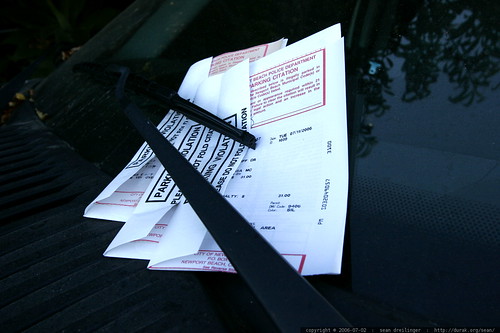
Growing up in Santa Barbara, I was raised to believe that parking in garages was always very cheap, and for the cost of slight inconvenience, you can park for free on a sidestreet. Paid parking in Goleta is unheard of. But going to school in Savannah GA, there is not a single free parking spot in the whole city. And ontop of meters at every spot, there's street sweeping to boot. Needless to say, I got more parking tickets than A's (I was a straight A student, of course, but I got a lot of parking tickets). However because each ticket was $12 or less, it was just an irritating part of life. Moving to Los Angeles after that, the tickets are $52 each, so getting a parking ticket means you have to wait until next week to buy groceries.

The fact is a car is a tremendous amount of space. The article describes how developers for banquet halls in Richmond, B.C. are required to provide up to four square meters of parking per every meter of hirable banquet space. Grocery stores have to sacrifice half of their property or more for empty pavement. And there's no efficiency equation involved: how many customers carpool?

But of course this is a loss-leader: how many would shop at a store that you had to pay to park? The cost of property taxes in this empty space is made up for in sales. But the problem is this completely discourages alternative transportation. Stuart Donovan and David Seymour, the authors of the article, describe how this taxation (paying for parking in the merchandise you buy) is more expensive for low-income customers who do not take advantage of the free parking by riding the bus. There is warrant to that argument, but admittedly it really stretches the case.

The problem I don't think is addressed is alternatives. First, how many customers know about this? It's something that's very obvious, but not really noticed because we take it for granted. How large of a percentage of our bill goes toward parking, let alone gas and the cost of owning a car at all? Second, how about adding an incentive to not driving or carpooling? A lot of stores already offer a $.05 discount for every reusable bag you use for your groceries (instead of using their plastic bags). How about deducting $1 if the person brings in a bus voucher?

But unfortunately solutions won't come anytime soon. Grocery stores, or any stores for that matter, are only concerned with massive amount of customers making even more massive amounts in purchases, and making the matter difficult or appear more expensive to the customer will only scare them away. Probably the best solution is just informing the customer via posters and printing on the receipt (but then I guess that would leave the next campaign to be about saving paper.)

Jul 13, 2009

rocket built by a six year old


My second drawing request to John Gholson was for a "rocket built by a six year old," and he delivered his own interpretation: the rocket he built when he was six years old.

He tweeted about it the day before, with "Stumped by @brandonthebuck's request, between giving him what he probably expects and giving him my interpretation." His final drawing is very personal, and it delivers on what I wanted: his interpretation.

Thank you, John.

Jul 9, 2009

Little Brother's growing up

Brandon Buck - Amateur Extraordinaire

(Republished from the Causecast Blog)

by Brandon Buck

Last week I was doing my morning run (and by "run," I mean walk halfway down the block and have 2 grilled cheese bagels sprinkled with smore's flavored protein powder), and down the block were two men crouching next to a company van. Did they hit something? Didn't look like it. Then I noticed two large paint buckets, one of them being poured out by one of the men. I moved a little closer and saw that the van was a carpet cleaning service, and the water they were dumping out was blue and foamy. They were dumping their waste cleaning chemicals down the storm drain! As I walked up faster and pulled out my iPhone from my pocket, the two men saw me and quickly got in and drove away before I could take a picture.

I'm still amazed at how people do something so clearly illegal in broad daylight in open public. How stupid could they be to do this in the suburbs and think no one would notice? Or how inconspicuous it looks to quickly drive away when someone walks up? I was furious for the rest of the day that my phone was too slow to load up the camera and I could have emailed the pictures on the spot to the Santa Monica police.

The term "Citizen Journalism" has been tossed around a lot for the last few years. "Little Brother," the reversal of 1984's "Big Brother" to describe how we're being watched by the common everyone, has been used for decades. It's always been a pretty novel movement and a huge headache of dead-tree newspapers for the last ten years. In fact traditional news sources were pretty dumbfounded on how to handle it (remember Steve Jobs' death? No, the one before that that headlined CNN for a day). Major things happen everywhere all the time, the challenge has been getting the information out. Thanks to the digital age, information is fast (and as the case with Steve Jobs' falsely-reported death, sometimes too fast). But ways to take action are limited. Sometimes impossible.

The first step to making a difference is to know the problem at hand. The second step is knowing how to take action, and the third step is informing those who need to help you take action. We here at Causecast spend every day just filtering through the information to try to give you the second and third steps. But that's a truly daunting task. There's nowhere near the capability for us to cover it all. So we have to rely on our users to tell us what's going on.

We've been working really hard on the new Causecast site to do exactly that: give you the tools to let let the world know what needs to be done and how to take effective action. There's no one more excited about Causecast 2.0 than us, but what's really exciting is seeing what you guys are able to take out of it.

Jul 8, 2009

Living By Numbers

Because of working late nights and weekends at Causecast, I've barely been able to touch my only magazine subscription to Wired for the last three months, so writing this is really slow coming.

The recent issue headlines with "Living By Numbers," which is a sentiment I agree with, though the article's very obsolete and missing massive chunks of its own theory.

First, it's really irritating that Mark McClusky capitalizes the phrase "Living By Numbers" throughout the article as though he's patented the phrase. Clearly he wants this to be the next "Long Tail," which was also created by a Wired editor Chris Anderson, but again, this is nothing new. In fact the headlining story, "The Nike+ Story," is based on a 3-year old device. That's like writing an article about the iPhone next summer. Sure, you can only write so much without a large set of data, but the "Living By Numbers" theory runs more hand-in-hand with this single device in the article than about the lifestyle it's trying to describe.

The related stories in the piece mildly talk about tracking diet, sleep cycles but there's a HUGE story they're missing: genomics. 23andMe was founded at the same time the Nike+ was announced, and the entire model of the company is to map out our DNA into a digital file that we can analyze, track and calculate. J. Craig Venter has already been interviewed by Wired a number of times on gene sequencing. Calorie intake and burn are great to track; weight, speed, chemical balance are all important numbers to track, but knowing the foundation on what makes us at all is the single biggest element of Living By Numbers.

Additionally, the article hints at what Living By Numbers is really about: the industrialization of the living. 300 years ago, manufacturing of goods was industrialized for hyper-efficiency and there was a revolution in the Western world. 200 years ago residential development was industrialized and there was a revolution in lifestyle in America. 50 years ago there was a new industrialization of commerce and industry as everything moved to computers and digital tracking. Working for an internet startup, I deal with this every day where we both look at newly-released tools to make our chores hyper-efficient and track our personal wages by the hour to see whether a task in the office is worth the time completing. Working by Numbers. Now we're looking at our own bodies as a machine that can be made more efficient if we just apply the numbers to an algorithm.

The article also doesn't put in any evidence to falsify the theory. Of course McClusky never states that this is a scientific theory and that there's any quantifyable evidence of the matter, but there should have at least been a statement by someone who believes on the contrary, that this movement could be harmful or ineffective. The charts show a gradual increase in effeciency, but at some point there is a levelization where the human body simply cannot achieve more.

The side articles are the most worthwhile portions of the story: "Exercise," "Nutrition," and "Health," because it describes several other components that drive the Living By Numbers theory. I use Runkeeper to track my run and have wanted a FitBit since they were first announced at TechCrunch50 (Runkeeper talked about the Nike+ in their blog after this article came out, but mostly addressing the limitation of Nike+ tracking your foot impact as a measure rather than GPS, thereby severely limiting how many exercise routines to track [biking, skiing, rowing, etc.])

The article isn't wrong by any means, just incomplete and outdated. What would be the theory now? My thoughts on the theory is that we've recognized the limitations of Living By Numbers after the economic crash, where our application of numbers into every component of our lives isn't necessarily the truth of the matter. Wired covered this a few months ago with the Gaussian copula function that blew up in the face of banks loaning money. The Eating Local movement is essentially about disregarding the efficiency of industrialized farming. Live experimental theater being on the rise and digital music on the fall. Many, many things.

Or maybe I'll just admit that Living By Numbers doesn't work for me and I'm still a bad runner.