This is a long (97min) talk held at one of the Google campuses earlier this month from an all-women panel of mobile app designers. For the most part, they talk about how important it is to listen to your users to figure out how best to serve your app or what direction it should be going, but a few notes that stuck out to me were:
It's essential to release your app as soon as possible with bare-minim of features; if you get carried away with what it could have, you'll spend forever in development.
People don't want one app that does everything, either. Keep the UI very plain (ie no fancy tactile functions). This reminds me of the comparison with FourSquare (very simple) to Gowalla (like a Flash restaurant site made in 2000).
People search more than browse.
2 second page load = people think the app is broken. People have less tolerance for speed on mobile than for web.
Take your phone out into the sun to see how people will see it in use.
This weekend I watched this video segment from Criterion's DVD of Che, which focuses solely on what the filmmakers were up against when using a production model of the RED camera, which at that point hadn't ever really been out on the field.
It's pretty fascinating how everyone was so passionate about putting RED into the pipeline and going out of their way to handle all of the bugs they encountered, when they weren't really going for anything extraordinary. Star Wars II I can picture had tons of problems all over the place because it was the first digital feature *ever,* and there wasn't anything to compare it to. I imagine The Matrix's bullet-time effects caused a lot of headaches because those were some really complicated, incomparable shots, and the filmmakers probably weren't even sure if they'd come out right. But by the time Che was in production there was already the Genesis, VIPER and two generations of Cinealta; what was the fuss about with the RED (and especially when Soderbergh admits he's not crazy about shooting to 4K)?
Though I did like to hear two things from this. One was Soderbergh editing the film in the back of the car as they're driving to location for the day's shoot. This is something I've done a few times, and the fact that he's doing this optionally (ie not because they were under a time-constraint) really shows how passionate he was about the project, because under every one of those times I edited while on location or traveling I was always exhausted and jealous that everyone around me was sleeping.
The other part was how Soderbergh acknowledged the time save by having everything digital, and that it allowed the filmmakers a chance to reflect on the film and carefully weigh their choices in the edit. A few years ago when digital cinema was really exploding, there were stories of actors going berserk when shoots wouldn't end and directors were getting carried away with weeks worth of footage. To Soderbergh's argument though, Pirates of the Caribbean 3 was under such an incredible rush to delivery that director Gore Verbinski never had a chance to see the entire cut of the film from start-to-finish in one sitting.
Designers Jr.canest (Jorge R. Canedo Estrada) and Kasey Lum worked with Jason Toff from Google to put together the new series of short videos that go in-depth for Google Voice.
I really, really love these spots; they're amazingly well-done, they have their own style but still with that "Google" gloss, and it's ultimately a 10-minute instructional piece that's broken down to be easily digestible/shareable/referenceable (and, of course, these spots were really great to come out when they did because I've been trying to convince some of my friends whom I've shared invites with why it's actually useful). Google's original spot was good, but they ultimately were cramming too much info into too short of a timeline.
I'm thinking this is also a trend for Google to reach out with their creative department: I just learned last week that the really short, hand-made Chrome Features spots were done by 1st Ave Machine.
I've been a huge fan of Canest ever since I saw his reel on Vimeo, and was even more impressed (and slightly depressed) to find he's only 20 and already successfully freelancing out of college (Vancouver Film School).
Reel:
Jorge and Kasey worked together on a music video for Broadcast 2000 (same band as for Jorge's reel)
This video is basically the pinnacle of YouTube as of right now:
Hand-made Stop Motion
Cheap digital still cameras and the huge pop-culture success of Michel Gondry 2006-2008 made everyone want to emulate stop-motion animation. People share these like crazy. It's awesome, but I think it'll finally wane by mid-2010.
Full HD
360p to 1080p, this video can be viewed on as low- or as high-quality as YouTube can offer, and on any device YouTube can stream to.
Cute
Vocal sound effects and catchy, simple music recorded on a desktop computer.
Shot at home in a basement.
Expressive faces, like something out of a high school skit.
Action Annotations
Credits for the video aren't just names, they're links to their profiles, encouraging you to subscribe. Like the music? Go to the musician's page and hear all of their songs. And because it exists on the video itself ("baked-in"), the links work no matter where it's posted: MySpace, Facebook or this blog.
Sub-video categories
Jump to the behind-the-scenes companion video literally as the video's still playing.
Links everywhere
The description has links to buy the song in 3 different places, to each filmmaker's YouTube page, Twitter, Facebook and DailyBooth.
Merchandising like crazy
You can buy the song (both with and without lyrics) and all the shirts, and AdSense on the video are all revenue models for this one piece: the video is a vehicle for the sales, and the sales are only possible from the video. 1000x more bang-for-the-buck than the Transformers franchise.
Saw this video on the Vimeo Staff pics. Really simple, really elegant, really creative. The creator of the piece, "barno," describes it simply as "Musicvideo about the relation of light, music and architetcture."
It reminds me of the KHRONOS Projector, which displayed an image and moved forward in time the harder you pressed into the screen.
Pretty remarkable to combine the two projects: pressing the screen moves forward/backward in time, alters color and creates music. I think it's pretty safe to assume all media is moving toward a synesthesia-like experience.
Got a link this morning that said it would be about how WIRED is prepping their new form of digital publishing for the iPad, though it's actually an Adobe commercial about how Flash is keeping up with the technology.
These concepts they're showing are obviously awesome, and I'm sure specifically Adobe's bidding war for WIRED exclusivity was an arm and a leg alone. WIRED clearly has a lot of tricks up their sleeve that they've been holding off for a while in anticipation, and I'm really pleased that the ideas go beyond the concepts Popular Science had in their video (which I blogged about earlier before the iPad was announced).
As they say in the video, it's a really exciting time for publishing. And that could be said for all content publishing, not just magazine print. Andy Ihnatko had a prediction that as soon as Apple announced their product, every computer manufacturer and design software company would finally release their products to compete head-to-head (they just held back so far to simply know what they'd be up against), and that's clearly been happening in only a short month.
Not only are the concepts here really great, as I said, but this is also going to be a really huge year simply in terms of how any publisher online is presenting their content. One major site that I know of is changing their layout entirely in a way that really takes advantage of how it interacts with multi-touch (and yet is still perfectly functional via keyboard and mouse).
One final note I think is pretty interesting is how a lot of publishers and advertisers have basically been setting the stage for this kind of media, whether they were aware of it or not. Shopping malls have been using large plasma screens lately to add life to their images (literally the case with the movie posters for Step Brothers and Bride Wars), and two years ago Esquire made a really huge change in their pipeline by doing their Megan Fox cover shoots with a RED One video camera (instead of the standard medium-format).
The only downside, of course, to all of this is how WIRED will be having to using Flash for their site, which will make things slow, large, difficult to search and share, and hold everything behind a different kind of paywall that a lot of publishers are playing with. Competition's good: it'll bring a ton of creative and technical innovation that'll be really exciting, but it'll also bring a long road of awkward pricing and saturation in the market (like the music industry, film industry and now e-book industry). I predict it'll actually be around 3 years for the print-publishing industry to make sense of it.
UPDATE: Volvo announces touchscreen-based rear seat entertainment system
Evidence that hardware and software manufacturers were just waiting for Apple to announce something before launching their products, and proof that everything (everything) moving in the multi-touch direction.
I just watched this video about an Algae Bioreactor (I think it's homemade) at night, and love the "interior lighting" system the guy employs to check the progress of the material culturing (I really know nothing about making algae fuel).
He uses a fluorescent light, which I'm assuming is a typical 2700K (cool/white), and the color of the batches are based on the progress of its culturing.
So lets imagine a 2-lighting system- one light being 2700K so we can verify the progress of the culture, and the other being a custom colored light (or 3-tone LED array). If I understand additive color correctly, could you provide a strong red light to get yellow, or a strong blue light to get cyan? If the light were magenta, would the batch appear white?
Because I want to know, in theory, if you were to assemble a 13,536,000 gallon factory, could you essentially build an iPod Nano screen viewable from space?
As chef Andrew Gruel and marine biologist Dave Anderson cooked, the video team captured them on camera talking about the history of their organization, why it’s important to maintain seafood as a part of a healthy diet and how they’re going about convincing the fishing industry and the restaurant industry to go sustainable. They also explained the incentives they offer customers who choose sustainable dishes.
Because Andrew and Dave had so many insightful things to say, we did something a little special with this video. Normally our videos are around three to four minutes long, so we also provided links in the video to other parts where Dave and Andrew go into more detail about certain things, whether it’s more on the health benefits of having seafood in your diet, or about how you can shop sustainably at your local grocery store or restaurant.
We also couldn’t leave you without recipes of all the delicious dishes Andrew made, so we included links at the very end of the video that you can click on that will take you directly to the recipes.
- - -
I was really happy with how this video mini-series came out. I had 4.5 solid hours of footage to work with, and I didn't want to spend too long editing so many things because it was still more of a conceptual piece that showed how video could be more interactive. If given long enough time, we would have eventually gone into each dish individually, more about sustainability for each ingredient, etc. There are so many directions to go, but ultimately I hope we do more like this in the future.
The resounding disappointment in the launch of the iPad was the fact that it was really nothing more than a larger device that's been around for two and a half years. Any revolution that this thing would cause should have already taken place, right? Well, not necessarily. Size matters.
Once the App Store launched a few months out, the initial apps were pretty basic and were really like glossy toys: UrbanSpoon and Labyrinth utilizing the accelerometer, Ocarina and Shazam using the microphone, Bebot and iSteam using the multi-touch screen and so on. They're all really cool, but really just toys. Google Maps ported over their service to work with the iPhone, and Apple had their Remote to help you better use iTunes while at home. Two years later, the apps don't really use the iPhone's abilities as a toolset anymore, they're really just utilizing the giant swarm of users and massive amount of quick money some have earned when apps get popular. So the apps developed for the iPad will probably not be revolutionary toys so much as tools for a massive user base.
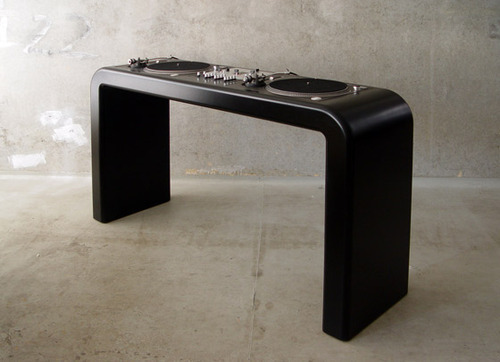
The image above is a simple, elegantly-designed turntable I stumbled on. Turntables and keyboards will be to the iPad what flashlight apps are for the iPhone.
This is a quick mockup by Stu Maschwitz, developer of the Magic Bullet Coloring software used by amateur and professional filmmakers, imagining his application on the iPad. Pretty cool, right? How about knowing that it'll replace 80% of the market for this:
This is the Black Magic Design DaVinci Resolve, which is the color timing table for most everything out of Hollywood (and student films if they can afford it). These things cost hundreds of thousands of dollars, and color-grading by professionals cost $50-$1500 per hour (depending on the format and additional services [syncing sound, rotoscoping, etc]). How long before that table of 100 knobs becomes a table of 3 iPads?* All Red Giant needs to do is sell Magic Bullet as a $250 iPad app.
WebTV was supposed to be a complete revolution in entertainment. It was to combine television viewing and internet browsing in one. Eventually it could have lead to DVR's, sharing clips over email and eventually social networks, live broadcasts, interactive advertisements, purchasing items on shows while you're watching, and so on. Could have. It was slow as molasses if it ever worked at all, buggy, expensive, and dead in the water within a few months, even after being purchased by Microsoft. Networking issues aside, who thought it'd be a great idea to be reading type twenty feet away on an interlaced screen (remember, these were the days before HDTV)?
Today, it's hard to nail how people really consume entertainment. More watch video online than on television, however the numbers aren't from streaming feature films. People watch bite-sized chunks on their computers, and more are moving to their mobile devices. Films and television, though with decent success on Hulu, haven't killed cable. In fact cable providers are trying to build a good symbiosis with your television set and your computer, but acknowledging both as separate devices.
Well guess what, Apple made a point to call the iPad a new appliance; not "laptop" or "phone." So let's imagine WebTV as not a black keyboard on your lap, but a multi-touch remote control that compliments what occurs onscreen. Remember that scene in Tomorrow Never Dies where James Bond drives the car from his phone?
Boom.
Of course, I recognize the irony in criticizing 1990's technology and then referencing 1990's future tech in the same paragraph, but I'm certain we'll be coming across tons of great uses of the functional device on our lap that controls what's onscreen. Read the tea-leaves closer, and I'd point out that Apple has decidedly not developed the Apple TV whatsoever in the last few years because they may be holding some sort of new development for the right point of time. The Apple TV essentially throws online content to your television, but a 6-button controller has been way too limiting to do anything worthwhile.
I love my iPhone. Like, love it. We legitimately need larger real estate for everything the iPhone can do to be best utilized, which the iPad will bring. I just doubt the iPad as it appears now can be as functional as a virtual mouse as I'd like it to be (how can I use it with Final Cut Pro? Photoshop? After Effects?). Maybe I will stick with the ModBook after all.
- - -
*(I didn't say the DaVinci was completely obsolete or that color grading is now entirely in the hands of the filmmaker, because though they may be really expensive, a good grader is worth their salt and can really save a lot of mistakes made in production.)
A) No calls from the creep.
B) Mankind is assisted.
C) Over the long term, because there's now a cost associated with asking a girl's number, you have been deemed worth the risk.